

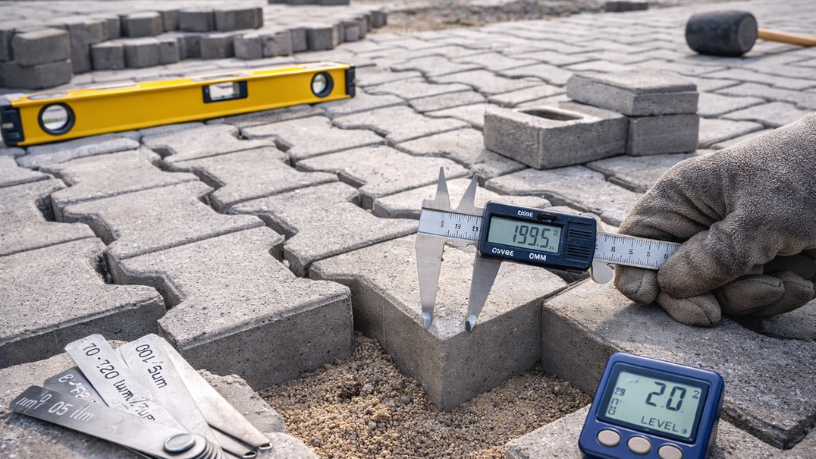
According to engineer Valderci Malagosini Machado, dimensional control in interlocking concrete units is one of the most decisive factors in ensuring precise fitting, efficient interlock, and long-term pavement stability. Small variations of just a few millimeters can compromise structural performance and lead to pathologies over time.
In this article, you will understand how strict dimensional accuracy directly impacts paving quality, what the main risks of poor control are, and which practices elevate production standards. Continue reading and evaluate whether your process truly meets the technical demands of the market.
Why Is Dimensional Control So Important?
Interlocking pavement systems rely on the mechanical interaction between individual units. Unlike monolithic solutions, performance depends directly on the correct fit between blocks. According to well-established technical criteria, any dimensional variation beyond tolerance compromises alignment and reduces the efficiency of the interlocking mechanism.
Dimensional uniformity ensures proper load distribution. When pieces present differences in length, width, or height, stress concentration points emerge. These points promote displacement, uneven surfaces, and, in more severe cases, premature pavement failure.
How Does Fit Influence Pavement Interlock?
Precise fitting ensures that forces applied to the pavement are transferred laterally between units. According to sound engineering practices, effective interlocking reduces individual block movement and increases the overall resistance of the system. This behavior only occurs when dimensional tolerances are properly maintained.
As engineer Valderci Malagosini Machado highlights, units with excessive variation create irregular joints. Joints that are too wide facilitate the loss of jointing material, while overly tight joints hinder proper seating. In both cases, the result is progressive instability, particularly in areas exposed to heavy traffic.
Main Impacts of Dimensional Variations
Lack of dimensional control leads to consequences that go far beyond aesthetics. It directly affects structural performance and pavement lifespan.
Among the most relevant impacts are:
Difficulty in installation and increased construction time
Formation of irregular joints
Reduction of lateral interlock
Development of localized settlements
Higher incidence of edge breakage
Each of these problems compromises the stability of the entire system. As engineer Valderci Malagosini Machado states, the accumulation of small imperfections can result in significant structural failures over time. For this reason, dimensional control must be treated as a strategic priority rather than merely an operational step.

Which Factors Affect Dimensional Precision?
Several elements of the production process directly influence the final dimensions of interlocking units. Mold quality, vibro-compaction adjustments, and moisture control in the mixture are key determinants. According to industry technical parameters, even small variations in moisture content can alter the behavior of concrete during molding.
In this regard, engineer Valderci Malagosini Machado points out that equipment wear and lack of preventive maintenance affect measurement repeatability. Worn molds tend to produce units with deformed edges or inconsistent dimensions. Process standardization and periodic inspections are therefore essential to maintain precision.
How to Ensure Long-Term Stability and Performance
Ensuring stability begins with planning and rigorous control. It is essential to establish clear tolerances and perform frequent measurements during production. According to effective quality control practices, continuous sampling allows deviations to be identified before large production batches are compromised.
Production traceability also strengthens technical management, as emphasized by engineer Valderci Malagosini Machado. When a company documents batches, dates, and operational parameters, it can act quickly when inconsistencies appear. This preventive approach reduces waste, avoids rework, and increases credibility in the marketplace.
Towards Safer and More Durable Pavements
In conclusion, dimensional control in interlocking units is not a secondary detail. It is the foundation for proper fitting, efficient interlocking, and structural stability of the pavement. When the industry neglects millimeters, it assumes risks that can compromise the entire project.
Therefore, investing in technology, workforce training, and continuous monitoring of the production process is essential to achieve excellence. Dimensional precision ensures performance, reduces pathologies, and strengthens a company’s reputation. By understanding that every millimeter matters, manufacturers and builders can deliver pavements that are safer, more durable, and more competitive.
Author: Diego Rodríguez Velázquez