
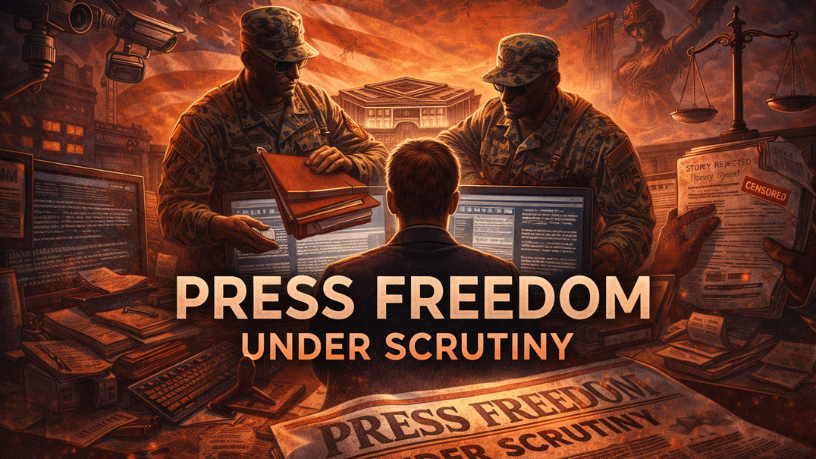
Press Freedom Under Scrutiny has emerged as a central issue in the United States following recent changes in the relationship between the Department of Defense and a long-established military news outlet. The decision to alter editorial oversight structures has triggered concern among journalists, legal scholars, and press freedom advocates. Press Freedom Under Scrutiny reflects a broader national conversation about the boundaries between governmental authority and independent reporting. While the publication in question has historically served military audiences, its role has extended far beyond internal communication. The situation has drawn attention because it touches on transparency, accountability, and democratic norms. Observers note that even subtle shifts in editorial control can have lasting consequences.
At the heart of Press Freedom Under Scrutiny is the question of whether institutional influence can coexist with journalistic independence. Critics argue that direct oversight by a government department creates an inherent conflict, even if no immediate censorship is evident. Press Freedom Under Scrutiny highlights how structural changes alone may shape newsroom behavior over time. Journalists working under such conditions may feel pressure to self-censor or avoid sensitive topics. This concern is not limited to a single outlet but resonates across the media landscape. The case has become a reference point in discussions about safeguarding editorial autonomy. The implications extend beyond military journalism.
Press Freedom Under Scrutiny also raises legal and constitutional questions. Freedom of the press is a foundational principle in the United States, designed to function independently from executive power. Analysts emphasize that the strength of this principle depends not only on law but on consistent practice. Press Freedom Under Scrutiny illustrates how deviations from established norms can challenge public confidence. Even when actions are framed as administrative or operational, their symbolic impact matters. The perception of government influence can be as damaging as direct interference. This dynamic has fueled ongoing debate among constitutional experts.
The response to Press Freedom Under Scrutiny has been swift among advocacy organizations. Press associations, former editors, and civil liberties groups have publicly expressed concern about precedent. They argue that allowing increased editorial control by a defense institution could normalize similar practices elsewhere. Press Freedom Under Scrutiny therefore becomes part of a wider discussion about media independence in times of political and institutional strain. The reaction underscores the interconnected nature of press ecosystems. What affects one outlet may influence expectations across the industry. This collective response reflects heightened sensitivity to institutional overreach.
From a journalistic standpoint, Press Freedom Under Scrutiny underscores the importance of clear separation between reporting and authority. News organizations that cover powerful institutions must retain the ability to report critically without fear of reprisal. Press Freedom Under Scrutiny brings attention to how governance structures can subtly shape editorial priorities. Journalists emphasize that independence is not only about content approval but about editorial culture. When lines blur, trust erodes. Maintaining credibility requires visible safeguards that protect newsroom decision-making.
Press Freedom Under Scrutiny also resonates with broader public concerns about transparency. Citizens rely on independent journalism to understand how institutions operate, particularly those linked to national security. When editorial independence is questioned, so is the reliability of information reaching the public. Press Freedom Under Scrutiny thus connects media governance with democratic accountability. The issue has gained traction because it affects how information flows within a democratic society. Public trust depends on confidence that reporting is free from institutional pressure. This trust is difficult to rebuild once weakened.
International observers have also taken note of Press Freedom Under Scrutiny. The United States has long positioned itself as a defender of press freedom globally. Developments that appear to compromise that stance invite external scrutiny. Press Freedom Under Scrutiny therefore carries implications beyond national borders. Global media organizations and watchdogs monitor such cases as indicators of democratic health. The international dimension amplifies the significance of domestic decisions. Institutional credibility on the world stage is closely tied to internal practices.
Ultimately, Press Freedom Under Scrutiny reflects a pivotal moment in the ongoing negotiation between power and accountability. The situation highlights how editorial structures matter as much as editorial content. Decisions made today may shape media standards for years to come. Press Freedom Under Scrutiny serves as a reminder that press freedom requires constant protection, not passive assumption. The outcome of this debate will influence how journalism and institutions interact in the future. The broader question remains how democratic societies preserve independent voices amid growing institutional complexity.