
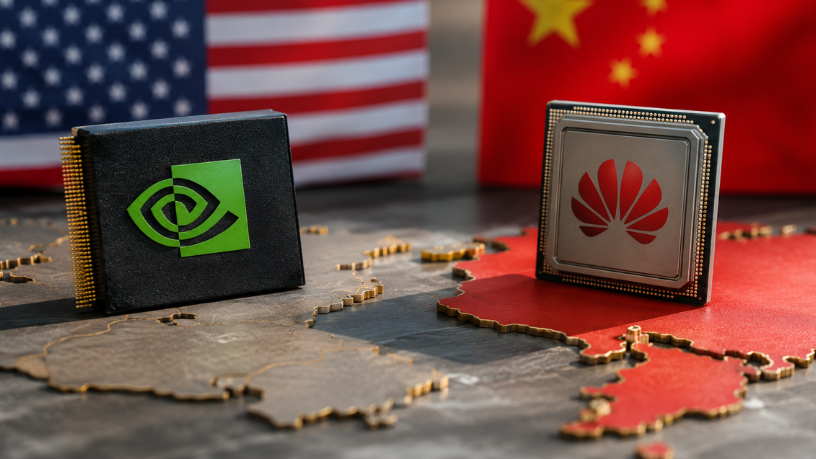
American trade restrictions are reshaping the AI chip race and giving Chinese rival Huawei room to advance.
The rivalry between the United States and China over dominance in artificial intelligence chip production has entered a new phase in recent months, and the numbers are starting to show an uncomfortable shift for Nvidia. After more than a year of back and forth on American export rules, the company led by Jensen Huang acknowledges it is struggling to regain ground in the Chinese market, just as rival Huawei advances with its own processors, such as the Ascend line. The situation reflects a series of decisions by the U.S. government that have alternately loosened and tightened the sale of advanced chips to Chinese companies, creating an environment of uncertainty that, according to Nvidia itself, is already directly affecting its financial results. The outcome matters directly to American consumers and the tech industry, since the fight over this market has ripple effects on investment, jobs and the pace of AI innovation in the country.
How We Got to the Current Round of Restrictions
The recent chain of events began in late 2025, when the Trump administration decided to allow sales of the H200 chip to China, reversing a tougher stance adopted earlier. In January 2026, the Department of Commerce formalized that decision through a rule that imposed conditions industry experts called contradictory: a 25% tariff on advanced AI chips, a case-by-case licensing system replacing the previous blanket presumption of denial, and a volume cap that would allow roughly 1 million H200 units into the Chinese market. Shortly after, in May, the Department of Commerce tightened the rules again, publishing new guidance requiring an export license for any transfer of Nvidia’s most advanced Blackwell-series processors to companies based in China or Macau.
The practical result of these back-and-forth changes has been a stalemate. Even with formal approvals for small volumes of the H200, Nvidia says it has not recorded meaningful revenue from China in its latest quarterly results, as Chinese authorities have been encouraging domestic companies to avoid buying U.S.-approved chips and instead prioritize homegrown alternatives. Nvidia’s chief financial officer, Colette Kress, told investors the company does not know whether imports will actually be allowed into China, which led Nvidia to exclude any China data-center revenue from its projections for the year.
Huawei’s Rise and the New Balance of Power
While Nvidia deals with this regulatory uncertainty, Huawei is taking advantage of the opening created by American restrictions to strengthen its own line of AI processors. Beijing has been encouraging Chinese companies to prioritize domestically produced silicon, a push that intensified after China’s Ministry of Industry and Information Technology instructed AI companies to avoid using the H200 even after it was cleared for export by Washington. Trade press reports indicate that as early as May, Jensen Huang himself reportedly told analysts he considers the Chinese data-center market largely lost to the local competitor, at least in the short term.
This shift has had a direct impact on Nvidia’s industrial strategy, which has redirected part of its China-bound production toward developing next-generation chips aimed at other markets. Analysts at the Council on Foreign Relations describe current U.S. policy as incoherent, arguing it acknowledges the national security risks of exporting advanced chips while still trying to preserve commercial space for American companies. In Congress, a bipartisan group of lawmakers has already publicly called for broader restrictions, including on semiconductor manufacturing equipment destined for China, arguing that targeted, company-specific controls have not been enough to stop China from working around American oversight.
What to Expect in the Coming Months
The regulatory standoff is unlikely to be resolved quickly. As the Department of Commerce continues adjusting licensing rules, American tech companies face difficulty planning long-term investments in a market whose regulations can shift every few months. This kind of instability is a concern not only for Nvidia but also for suppliers across the semiconductor chain, including lithography equipment manufacturers, which have been flagged in U.S. government reports over gaps in monitoring the final destination of exported products.
For American consumers and workers, the outcome of this dispute carries real weight: the semiconductor industry employs thousands of people in the United States and is considered strategic to the country’s leadership in artificial intelligence for decades to come. The question for the months ahead is whether Washington can strike a balance between protecting national security and keeping its tech companies competitive, or whether the ground lost to Huawei in China will turn out to be permanent.
Sources consulted:
https://www.thewirechina.com/2026/07/02/nvidia-uses-the-specter-of-huawei-to-make-its-chip-exports-case/
https://www.congress.gov/crs-product/R48642
https://modeldiplomat.com/story/us-chip-export-curbs-impact-nvidia-in-china
https://semiconductorsinsight.com/us-china-chip-export-controls-h200-2026/