

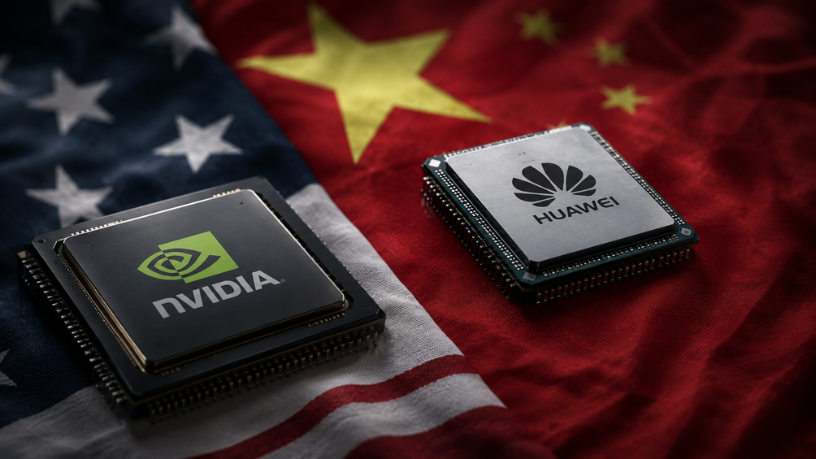
The competition to dominate artificial intelligence hardware has entered a new and unexpected phase inside China, where Nvidia, long the undisputed leader in AI chips worldwide, is watching its market share erode rapidly at the hands of a homegrown rival. Huawei has become the supplier of choice for major Chinese technology firms, a shift driven less by superior performance than by years of United States export restrictions that have made it increasingly difficult for American chipmakers to sell their most advanced products inside China. According to a recent report by ABC News based on wire reporting, Nvidia’s chief executive, Jensen Huang, was mobbed by admirers during a visit to Beijing in May, yet that celebrity status has not translated into commercial success for the company’s most powerful processors in the Chinese market.
Washington’s Export Controls Change the Playing Field
The roots of this shift trace back to a series of measures imposed by the U.S. government, which cited national security concerns to justify limiting the export of advanced semiconductor technology to China. These restrictions initially targeted Nvidia’s high end H200 chips, effectively freezing the company out of a market it once dominated. The Bureau of Industry and Security, part of the Department of Commerce, later clarified that these licensing requirements extend to any company headquartered in China or controlled by a Chinese parent, even when operations are based outside the country, closing a loophole that some firms had used to work around the rules. This clarification, first reported by Reuters and later confirmed by Al Jazeera, reinforced how seriously the current administration intends to enforce chip restrictions despite periodic policy shifts.
Huawei Fills the Vacuum Left Behind
With Nvidia’s most advanced products effectively unavailable, Chinese tech companies turned to Huawei’s Ascend line of processors, which has rapidly matured into a viable, if still less powerful, alternative. DeepSeek, the Chinese AI company often compared to OpenAI or Anthropic, confirmed that its newest V4 model, released in April, was specifically adapted to run on Huawei’s Ascend chips rather than Nvidia hardware. Analysts monitoring the sector believe collaboration between DeepSeek and Huawei is likely deepening as both companies work to train future models entirely on domestic infrastructure, reducing their dependence on American technology altogether.
A Gap That Still Favors the United States
Despite Huawei’s gains in market share within China, independent researchers caution against overstating the company’s technological parity with Nvidia. A study from the Council on Foreign Relations estimated that even if Huawei manages to manufacture around two million AI chips this year, that volume would represent only a small fraction of the total computing power Nvidia ships globally. Other industry estimates suggest that even in scenarios where Nvidia’s H200 chips are fully permitted for export to China, the United States would still hold a computing advantage measured in multiples of twenty to nearly fifty times over Chinese capacity, depending on how performance is calculated across current generation processors.
Nvidia’s Global Business Keeps Growing Regardless
Even as it loses ground in China, Nvidia’s overall business remains robust, buoyed by surging AI demand elsewhere in the world. The company has projected revenue near ninety one billion dollars for the quarter spanning May through July, a jump from nearly eighty two billion dollars in the prior quarter, and that figure excludes any data center compute revenue tied to China. For comparison, Huawei’s revenue over a similar period was reported at around one hundred twenty six billion dollars, though that figure spans the company’s much broader portfolio of telecommunications, consumer electronics and enterprise technology, not chips alone.
Enforcement Struggles and Gray Market Workarounds
The tightening of export rules has not been airtight. Reports cited by industry trackers describe Taiwanese authorities investigating individuals suspected of using forged documents to smuggle servers containing advanced Nvidia chips into China, illustrating how lucrative circumvention has become even as legal channels narrow. Huawei itself has reportedly built a stockpile running into the millions of chips manufactured by Taiwan’s TSMC and obtained through diversion schemes involving other Chinese firms, according to reporting cited by The Wire China. Analysts note that the very existence of this stockpiling effort suggests Huawei still cannot produce enough advanced chips domestically to meet demand on its own, which some experts interpret as evidence that export controls are working as intended rather than failing.
What This Means for the Broader AI Race
The implications of this standoff extend well beyond corporate balance sheets. Washington’s strategy rests on the idea that restricting China’s access to cutting edge computing power will slow its ability to train the most advanced AI models, preserving a strategic advantage for American companies and, by extension, national security interests. Beijing, meanwhile, is treating chip self sufficiency as a matter of long term economic sovereignty, pouring resources into companies like Huawei and SMIC even when the resulting hardware lags behind Western alternatives. The result is what some analysts describe as a deliberate bifurcation of the global AI hardware ecosystem, one track led by the United States and its allies, the other increasingly self contained within China.
A Policy Environment That Keeps Shifting
For American companies with significant exposure to the Chinese market, the unpredictability of the current regulatory environment has become a defining challenge in itself. Export rules have oscillated over the past year, from tightening restrictions to a period late last year when the administration considered loosening controls on H200 sales before reversing course again. This back and forth complicates long term planning for chipmakers and adds a layer of geopolitical risk that investors are increasingly pricing into the sector, according to analysis compiled by industry researchers tracking the policy.
Why American Consumers and Businesses Should Pay Attention
While the chip standoff might seem like a distant corporate rivalry, its consequences ripple into everyday technology used across the United States. The processors at the center of this dispute power the cloud services, AI assistants and data centers that increasingly underpin American businesses, from healthcare systems to financial services. A widening gap in computing capacity between the U.S. and China could shape which country leads in future breakthroughs, from medical research to autonomous systems, making this technical trade dispute one of the more consequential storylines of 2026 for anyone following where American innovation is headed next.
Fontes consultadas: ABC News, Al Jazeera, Council on Foreign Relations, The Wire China