

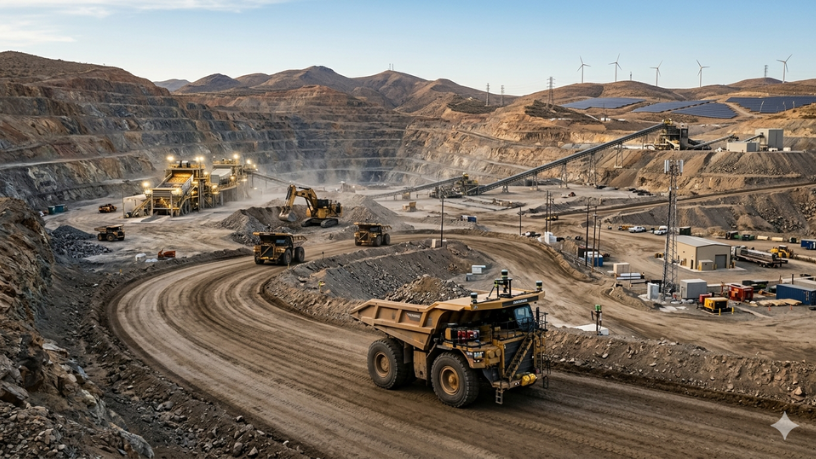
The global push toward net zero emissions is rapidly transforming the mining industry across multiple regions. Governments, investors, and corporations are beginning to view mining not simply as a traditional industrial activity, but as a strategic pillar of the worldwide energy transition. As a result, pressure is increasing for smarter, more sustainable, and technologically advanced mining systems. The discussion now involves productivity, environmental responsibility, automation, and energy security, all factors expected to shape the future of the mineral sector over the coming decades.
The expansion of renewable energy has dramatically increased demand for minerals considered essential for batteries, electric vehicles, solar panels, and advanced technological infrastructure. Copper, nickel, lithium, graphite, and rare earth elements have become strategic assets in an increasingly competitive market. However, the growth of mineral production also exposes a major contradiction. The same industry needed to reduce global emissions still faces criticism related to high energy consumption, environmental impact, and operational emissions.
Because of this, the concept of smart mining has gained significant traction within the sector. The idea goes far beyond upgrading machinery or modernizing equipment. It represents a structural transformation driven by automation, artificial intelligence, real time data analysis, and more efficient energy systems. The primary goal is to increase productivity while reducing waste, fuel consumption, and environmental impact.
This transition is happening because traditional mining operations are facing more severe economic and operational limitations. Mineral reserves are becoming deeper, extraction projects are increasingly expensive, and investors are demanding stricter environmental standards. At the same time, local communities are calling for greater transparency regarding the social and environmental effects of mining activities.
Digitalization has emerged as one of the industry’s main responses to this new reality. Smart sensors, remote monitoring systems, and automated operations help reduce operational failures while improving natural resource management. In large scale mining sites, autonomous trucks and digital control centers are already lowering logistical costs and improving workplace safety.
Beyond operational efficiency, energy consumption has become a central issue in the debate. Many mining companies still rely heavily on diesel and fossil fuels to maintain continuous operations in remote areas. As international pressure for decarbonization intensifies, corporations have started investing in equipment electrification, solar energy, battery storage, and hybrid energy supply systems.
The transformation also carries a strong geopolitical dimension. Countries rich in strategic minerals are now competing for investments connected to the global energy transition. The United States, Canada, Australia, and several African nations are seeking to expand production capacity while attempting to balance economic growth with environmental sustainability. In this environment, intelligent mining technologies may become a decisive competitive advantage.
Another important factor involves the security of global supply chains. The pandemic and recent geopolitical conflicts exposed how excessive dependence on a small number of suppliers can create serious economic vulnerabilities. This has encouraged governments and industries to prioritize mining projects that are more modern, efficient, and environmentally acceptable.
Despite the optimistic technological narrative, the industry still faces significant challenges. Implementing intelligent mining systems requires high investment levels, specialized labor, and strong digital infrastructure. Smaller mining companies often struggle to keep pace with this transformation compared to major international corporations.
There is also growing debate surrounding the true environmental impact of so called green mining. While intelligent technologies may reduce operational emissions, mining activity still causes substantial environmental disruption, especially in sensitive ecosystems. This reality continues to increase pressure for stricter oversight and more transparent production models.
In Brazil, the subject is becoming increasingly relevant as well. The country holds important reserves of critical minerals essential to the low carbon economy and could secure a strategic position in the international market. However, specialists argue that future competitiveness will depend on the country’s ability to incorporate technological innovation, regulatory stability, and modern environmental standards.
The global energy transition will likely be impossible without an expansion of mineral production. The real difference lies in how this production will be managed in the years ahead. Smart mining systems are no longer viewed merely as technological advantages, but as economic and environmental necessities within the global market.
The rise of intelligent mining demonstrates that sustainability and productivity can no longer be treated as separate objectives. In an international landscape increasingly shaped by energy disputes and ambitious climate targets, companies capable of combining operational efficiency, innovation, and environmental responsibility will be better positioned to attract investment and remain competitive in one of the world’s most strategic industries.
Author: Diego Velázquez